
A mobile billboard is a large-format advertising display mounted on a vehicle, trailer or purpose-built mobile media asset, and driven or positioned through targeted locations rather than staying fixed in one place. It brings the scale and impact of outdoor advertising straight to the audience, instead of waiting for the audience to come to it.
In this guide, we'll walk you through exactly what qualifies as a mobile billboard, how mobile billboard advertising works day-to-day in Australia, how it differs from traditional council-regulated signage, and why it's remained one of the most effective outdoor advertising formats since the 1980s. From VFL football grounds to state- and Australia-wide road safety programs like today's Transport Accident Commission (TAC) campaigns, this format keeps delivering.
What Size Is a Mobile Billboard? (The Industry Standard)
To be classified as a true mobile billboard in Australia, a display must measure at least 6m x 3m (6000mm x 3000mm). That's the recognised industry standard, and it's what separates a genuine mobile billboard from a smaller vehicle-mounted sign or light trailer advertisement.
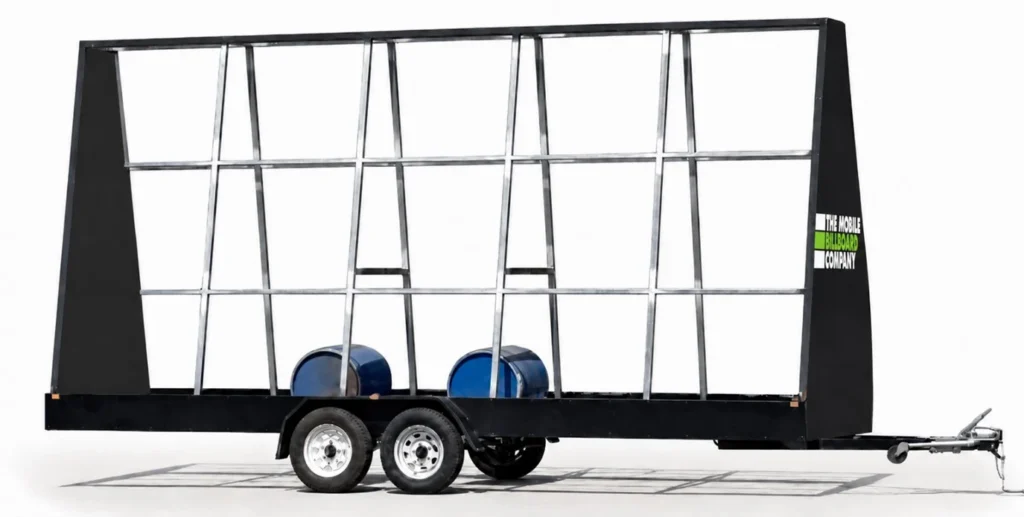
Unlike a fixed billboard, which stays in one location, a mobile billboard moves through targeted suburbs, shopping precincts, arterial roads, events, schools, business districts, and other high-traffic areas. In simple terms, mobile billboard advertising is outdoor media that reaches the audience where they are.
Mobile billboards are built to create high-impact, street-level visibility. They're commonly used for local-area marketing, event promotion, brand-awareness campaigns, retail launches, public-information messaging, and government safety campaigns. Because the display is mobile, advertisers can reach specific geographic areas without relying solely on permanent billboard sites.
How Mobile Billboard Activity Works
Mobile billboard campaigns are usually booked on a day rate basis, with activity typically running for up to 8 hours a day within the agreed campaign area.
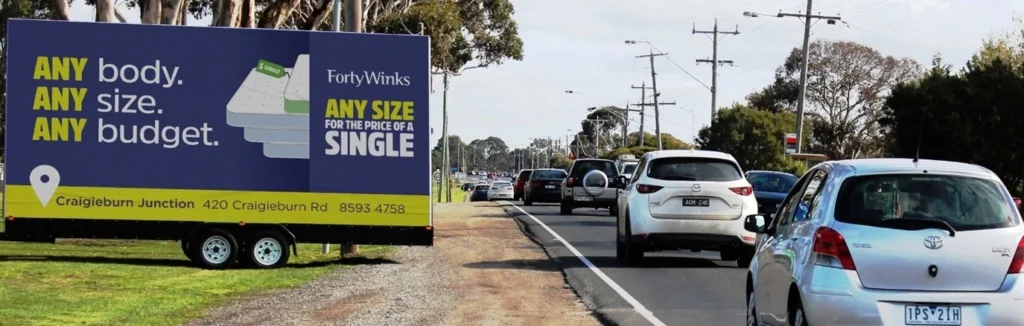
Rather than sitting in one fixed spot all day, the trailer is managed by an operator who circulates through the target area. That might mean local shopping strips, major roads, commuter corridors, schools, sporting precincts, retail centres, event locations, business districts, and other high-exposure spots relevant to the campaign.
The goal is repeated visibility across the local catchment. The operator moves between priority locations throughout the day, adjusting the route based on traffic conditions, time of day, audience movement and campaign objectives.
A local area marketing campaign, for example, might focus on school drop-off and commuter roads in the morning, shopping centres during the day, and main roads or community locations in the afternoon. Weekend activity is often weighted toward sporting grounds, markets and busy family locations.
This flexibility is one of the key strengths of mobile billboard advertising. The campaign isn't locked into one site or one audience. It moves through the area, builds frequency, and puts the message in front of people as they go about their normal day.
In most cases, the day rate covers the mobile billboard asset, the operator, vehicle movement, logistics and campaign activity across the agreed hours. That makes it a simple, practical way to access large-format outdoor advertising without having to buy media space across multiple fixed billboard sites.
How Mobile Billboard Activity Works
Mobile billboard campaigns are usually booked on a day rate basis, with activity typically running for up to 8 hours a day within the agreed campaign area.
Rather than sitting in one fixed spot all day, the trailer is managed by an operator who circulates through the target area. That might mean local shopping strips, major roads, commuter corridors, schools, sporting precincts, retail centres, event locations, business districts, and other high-exposure spots relevant to the campaign.
The goal is repeated visibility across the local catchment. The operator moves between priority locations throughout the day, adjusting the route based on traffic conditions, time of day, audience movement and campaign objectives.
A local area marketing campaign, for example, might focus on school drop-off and commuter roads in the morning, shopping centres during the day, and main roads or community locations in the afternoon. Weekend activity is often weighted toward sporting grounds, markets and busy family locations.
This flexibility is one of the key strengths of mobile billboard advertising. The campaign isn't locked into one site or one audience. It moves through the area, builds frequency, and puts the message in front of people as they go about their normal day.
In most cases, the day rate covers the mobile billboard asset, the operator, vehicle movement, logistics and campaign activity across the agreed hours. That makes it a simple, practical way to access large-format outdoor advertising without having to buy media space across multiple fixed billboard sites.
Short-Term and Extended, Flexible Mobile Billboard Campaigns
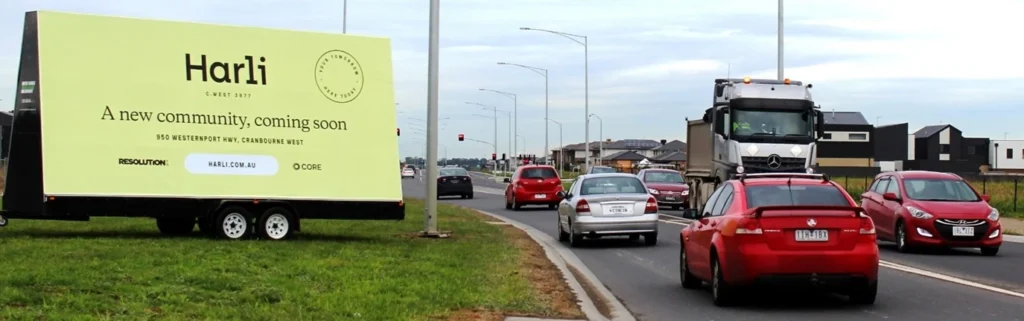
Mobile billboard campaigns can be booked for a few days or structured as a longer campaign running over several weeks. It's genuinely flexible, and getting the length right makes a big difference to how well the campaign performs.
Here's how the three main options stack up.
| Campaign Length | Best For | Why It Works |
| 3 to 5 days | Quick burst for grand openings, flash sales, one-off events and time-sensitive announcements | Gets a big, punchy message in front of as many people as possible in a short window |
| 5 to 15 days | The sweet spot for retail promotions, product launches, branding and local area marketing | Builds brand and messaging recognition with repeat exposure across the entire local area |
| A few days a week over several weeks | Long-term awareness, market saturation, dominance, government messaging and ongoing local presence | Spreads exposure across different days, traffic patterns and audiences for steady, compounding awareness. |
A quick burst of 3 to 5 days works well for events, grand openings, product launches, school open days, sales promotions or public announcements. It's about creating immediate, high-impact visibility in the lead-up to or during the key campaign period.
For most advertisers, though, 5 to 15 days is the sweet spot. It's long enough to build genuine recognition and repeat exposure across the local catchment, without the cost or commitment of a long-term booking. This is where the format tends to earn its keep, giving you enough runway to actually land the message rather than a single flash of visibility.
Then there's the long game: booking a few days a week over several weeks, rather than running consecutive days. A business might book 16 media days across four weeks, running 4 days a week. This spreads activity across different weekdays, weekends, traffic patterns and audience behaviours, and it's a smart way to build strong, lasting brand awareness over time.
Campaign days can usually be tailored to suit your objectives, budget and audience. A retail campaign might favour Thursday-to-Saturday activity. A school or childcare campaign might focus on Tuesday, Wednesday and Saturday. An event campaign might build activity in the week leading up to the event, then focus exposure on the event days themselves.
Mobile Billboards vs Council Signage Rules: Why They're Treated Differently
One of the biggest advantages of mobile billboard advertising is flexibility, particularly around local council rules.
Traditional signage is usually subject to council permits, planning controls and local laws. In most council areas, businesses can't simply place signs on footpaths, nature strips, roadsides, poles, public reserves or vacant land without approval. Portable signs, A-frames, roadside banners, real estate signage, temporary event signs, and promotional boards are commonly regulated because they can create visual clutter, block pedestrian access, distract drivers, or pose a safety hazard.
The City of Melbourne, for example, requires a permit for any portable advertising board placed in a public place, and Victorian planning guidance sets specific criteria around advertising signage and planning permits more broadly.
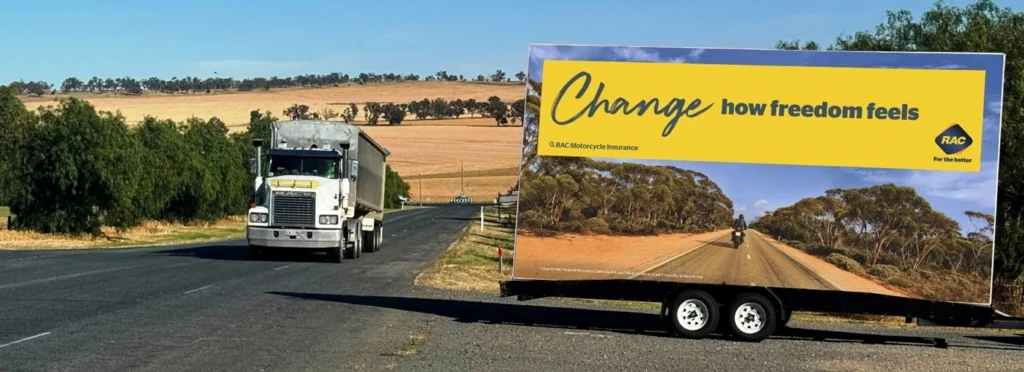
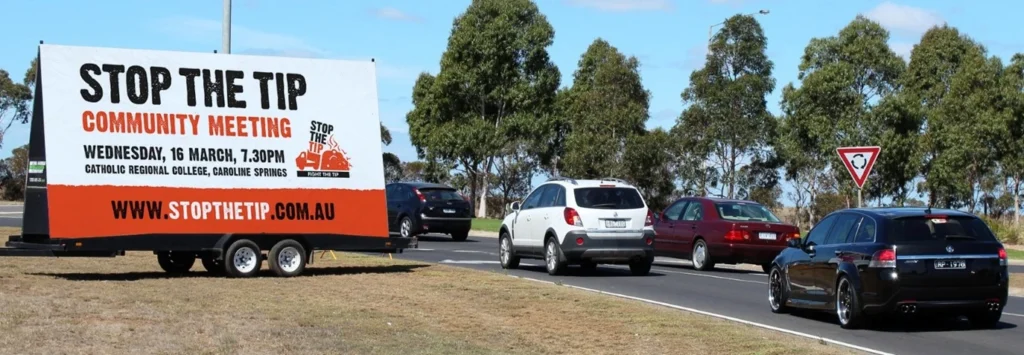
A mobile billboard is different because it's not an unattended sign left on public land. It's a registered vehicle- or trailer-based advertising asset, operated as part of a managed campaign. With a driver or operator in attendance, it can travel on approved public roads, local shopping strips, commuter corridors, and high-exposure suburban areas in ways that fixed or unattended signage simply can't.
That's why mobile billboards have become such a practical outdoor advertising format. They deliver the impact of large-format signage without requiring a permanent structure and without leaving promotional signage on council land. The asset circulates through the target area, pauses where it's safe and lawful to do so, then moves on as required.
It's a powerful combination: the visibility of outdoor media, the flexibility of a vehicle-based campaign, and the ability to target specific locations without relying on permanent billboard infrastructure.
The History of Mobile Billboards in Australia
How Mobile Billboards Began in the 1980s
In Australia, mobile billboards began to emerge in the mid-1980s as a practical, creative way to use large-format signage in areas where traditional billboard space was limited or unavailable.
The city and townscape of capital cities like Melbourne, Sydney and Brisbane looked very different back then. Many areas that are now busy suburban centres, growth corridors, and satellite cities were once semi-rural landscapes: open paddocks, market gardens, industrial fringe areas, or small townships on the outer edge of the metropolitan area. Suburbs that now have major shopping centres, schools, housing estates, business parks and constant commuter traffic were, at the time, far less developed and far less connected.
That also meant the outdoor advertising landscape was different. There were fewer established billboard sites in outer-suburban and regional-fringe locations, and road networks weren't as well developed as they are today. In that environment, mobile billboards had a genuine practical advantage, bringing large format advertising into areas where permanent signage either didn't exist, wasn't commercially viable, or wasn't yet supported by the level of development we see now.
As Melbourne, Sydney and Brisbane continued to expand, these once outer areas became important population centres in their own right. What were once paddocks and fringe roads gradually became major commuter corridors, retail precincts and high-growth residential suburbs. Mobile billboards suited this changing landscape well because they could move with the city's growth, placing messages in front of people where traditional fixed media hadn't yet reached.
Mobile Billboards and VFL Football
One of the earliest widespread uses of mobile billboards was around Victorian football matches, during the Victorian Football League (VFL) era. Football broadcasts were a huge part of Australian television culture at the time, with strong audience interest in televised matches and replays. For advertisers, that created a real opportunity: large-format signage positioned around football grounds could be seen not only by spectators at the venue but also by television audiences watching at home.
This made mobile billboard trailers a clever advertising solution. They could be placed near sporting grounds for maximum visibility, then moved to another location or event as required, giving brands flexibility, scale, and broadcast exposure without the need for permanent infrastructure.
From Advertising Medium to Road Safety Platform: TAC and Mobile Billboards
By the late 1980s, mobile billboards had moved beyond commercial advertising and become a highly visible public messaging tool.
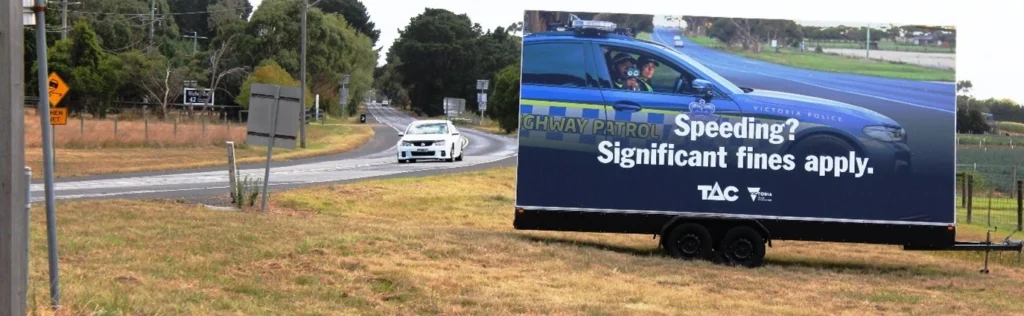
A prominent example is the Transport Accident Commission (TAC) in Victoria. Established in 1987, the TAC became known for major road safety advertising, including hard-hitting public education campaigns aimed at reducing deaths and serious injuries on Victorian roads. Around 1989, as road safety messaging became more prominent, mobile roadside billboard trailers were introduced as a practical way to deliver safety messages directly to motorists.
These mobile road safety signs became a familiar part of the Victorian road environment, appearing near high-risk roads, regional routes, black spot locations, holiday traffic corridors, and other areas where driver behaviour was a concern.
This is one of the reasons mobile billboards became such an effective format. They weren't just advertising to the general public. They were reaching people in context, and a road safety message placed beside a busy road had immediate relevance to those who saw it.
Why Mobile Billboards Still Work Today
The strength of mobile billboard advertising is its simplicity. A big message, in the right location, at the right time, is extremely powerful.
Mobile billboards work because they combine the scale of outdoor advertising with the flexibility of a targeted campaign. They can build awareness in a specific local area, support a new store opening, promote a school or childcare centre, drive traffic to an event, or deliver repeated exposure across a defined catchment.
Unlike many forms of media, a mobile billboard is hard to miss. It's physical, local and highly visible, seen by drivers, pedestrians, shoppers, commuters, parents, students and residents as they move through their normal daily routines.
Mobile Billboard Advertising Today
Today, mobile billboards are used across Australia by businesses, agencies, government organisations, property developers, retailers, schools, event organisers, community groups and public awareness campaigns.
The format has evolved too. While traditional trailer billboards remain popular, modern mobile billboard campaigns can include illuminated signage, digital mobile billboards, walking billboards, and GPS-tracked reporting, allowing advertisers to combine the impact of large-format outdoor media with better targeting, proof of activity, and campaign accountability.
From its early use around football grounds in the 1980s to its role in TAC road safety messaging, the mobile billboard has remained a powerful advertising format because it does one thing very well: it puts a clear, highly visible message directly in front of the audience.
Get Mobile Billboard Advertising Working for Your Brand
Whether it's local area marketing, an event campaign, or a government safety message, mobile billboards remain one of the most flexible and high-impact outdoor advertising formats available in Australia.
Because you work direct with our team, you avoid agency markups, enjoy shorter lead-to-launch times, and get completely fixed, transparent pricing. Reach out to our operation team today to map out the right layout locations, timing, and structural footprint for your next campaign.